Over the past two years, Annette Klinkert has been a driving force behind the COLOURS European University Alliance, providing dedicated leadership during a crucial phase of its development. With clarity, commitment and an inclusive spirit, she has helped shape the Alliance’s structures, strengthen cooperation among partner universities and turn shared ambitions into tangible achievements.
As Annette now steps down from her role as Managing Director, we take this opportunity to sincerely thank her for her dedication, professionalism and collaborative approach. Her leadership, guided by both strategic vision and genuine care for the people behind COLOURS, has left a lasting mark on the Alliance. We are pleased to announce that Dr. Wael Mousa will join the COLOURS European University Alliance as its new Managing Director, starting in January 2026. On behalf of the entire COLOURS community, we warmly welcome Dr. Wael and look forward to working together as we enter the next phase of our shared journey, strengthening collaboration, innovation, and impact across our partner universities.
Annette, your contribution will be remembered, and you will be greatly missed.

When you first took on the role, what was your vision for COLOURS, and how close do you feel the Alliance is to that vision today?
When I took on the role as Managing Director of COLOURS, I could already build on a strong, collaborative proposal-design process in which all nine partners had co-created the alliance’s concept and approach. From the beginning, my vision was closely linked to the European University Initiative’s ambition to foster deep transformation within and across academic institutions in Europe.
Personally, I hoped COLOURS would become a space that dares to expand and redefine what “excellence” means in times of complex societal, economic and political challenges — a space where open innovation and engaged research are not add-ons to “real” science, but central elements of responsible universities moving from topic-driven towards challenge- and impact-driven research and innovation.
Today, I feel that the alliance is genuinely on that path. The vision is not fully realised — transformation never is, especially after only two years. In some institutions, traditional metrics, hierarchies, and academic self-perceptions still stand in the way. But a shared direction is clearly visible in how students, staff, teachers, and researchers increasingly collaborate with regional partners across institutional and disciplinary boundaries.
Looking back on the past two years, what moments or achievements of the COLOURS Alliance make you most proud?
All achievements in COLOURS are the result of collective effort. What makes me most proud is that the alliance managed to overcome some fundamental challenges — learning to disagree constructively and to find new ways forward when a common language was not easy to establish.
Seeing students lead and facilitate hackathons, teachers and researchers engage in challenge-driven education, and regional stakeholders become co-creators of knowledge shows that COLOURS is not just talking about open innovation — it is practicing it.
The one achievement I am personally proud of is launching and chairing the Europe-wide Topical Group on Regional Innovation Ecosystems within the FOREU4ALL initiative. Today, this group connects 53 European University Alliances in an open community of practice and has positioned COLOURS as a strong and visible voice in the European university landscape.
What was the most rewarding part of leading a diverse European alliance like COLOURS?
COLOURS brings together nine regional universities with very different histories, profiles, and institutional cultures. Leading such a consortium meant embracing complexity, navigating change, and building trust every single day.
Very early on, I realised that leadership in this context could not follow a traditional, hierarchical model. Leadership is often compared to a “maestro” conducting an orchestra — providing direction, controlling the tempo, and ensuring precise execution of a predefined score. My experience with COLOURS showed me how limited this image really is.
Leading COLOURS felt far closer to playing in a jazz band. We did have a shared framework — the Grant Agreement — but leadership meant improvising within that frame, listening carefully, and trusting others to step forward. It required knowing when to take the lead, and when to step back and let others create their own solos. Real progress often emerged through interactions between students, researchers, staff, and regional partners.
In this setting, leadership was less about authority and more about motivation and connection — inspiring people to work towards a shared goal, empowering them to contribute their unique perspectives, and building relationships based on trust, expertise, and genuine care for one another.
Some of the most impactful leadership moments came from the Student Forum, from Work Package Leads, CIO Leads, CoSpace Officers, or Associated Partners. COLOURS showed me how crucial it is to design governance structures that enable leadership to be shared, distributed, and resilient — not dependent on a single person.
And I learned that, just like in jazz, dissonance and “blue notes” are not mistakes. They add tension, depth, and creativity. Without them, harmony becomes predictable and boring.
Disagreement in COLOURS often sharpened ideas and strengthened collaboration — as long as it was handled with respect rather than formal authority.
What impact has COLOURS had on students, staff and local communities so far, in your view?
I hope that for students, COLOURS opened doors to a new understanding of learning — one that values real-world challenges, collaboration, and responsibility alongside academic knowledge. I would be happy if students experienced that they are not only learners, but contributors to regional futures.
For staff, COLOURS created space to experiment with new pedagogical models, open science practices, and more collaborative governance approaches. This work is demanding — but essential for resilience in a changing world.
For local communities, COLOURS positioned universities as accessible and engaged partners in regional transformation, supporting green, digital, and social transitions through co-creation rather than one-directional transfer models.
What will you miss most about working with the COLOURS community?
I will miss the warmth, openness, and shared ambition of the COLOURS community — and the courage to remain ambitious at times when uncertainty often leads to hesitation. I will miss working within an alliance that understands competitiveness not as protecting old “silos”, but as activating all available knowledge in our institutions and regions — academic, societal, cultural, and technological — for the benefit of society.
Most of all, I will miss being part of a community that sees openness, inclusion, and self-reflection not as weaknesses, but as essential conditions for universities and regions to remain resilient and relevant in times of change.
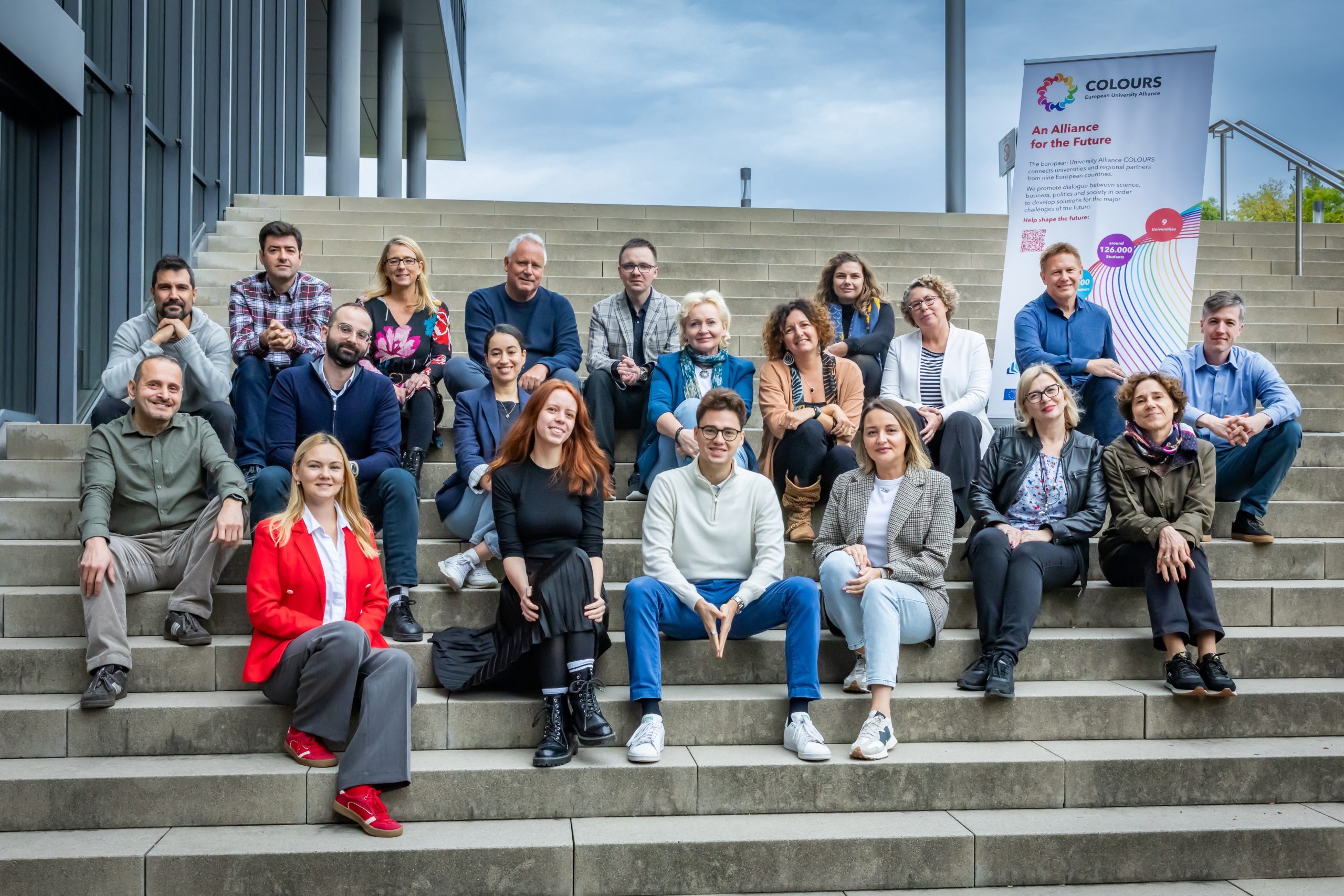
If you had to sum up your COLOURS journey in one sentence, what would it be?
My COLOURS journey was rich in colourful sounds and voices, and each of them reinforced my belief in the need for open, engaged universities working hand in hand with their regions.
Thank you for the music!